Classroom lesson · Grades 6-8

Spot the scam (grades 6-8)

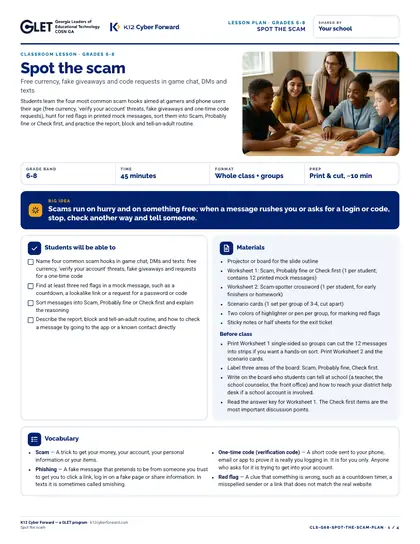
A ready-to-teach 45-minute lesson for grades 6-8: free currency, fake giveaways and code requests in game chat, DMs and texts. Big idea: Scams run on hurry and on something free; when a message rushes you or asks for a login or code, stop, check another way and tell someone. Includes a teacher lesson plan with scripts, student worksheets “Scam, Probably fine or Check first?” and “Scam-spotter crossword”, an answer key, 10 scenario cards, a 8-slide outline and a family sheet in English and Spanish.

Time to use
45-minute lesson
Audience
Teachers, Students
Grade band
Grades 6-8
Language
English and Spanish
Formats
DOCX, PDF, PPTX
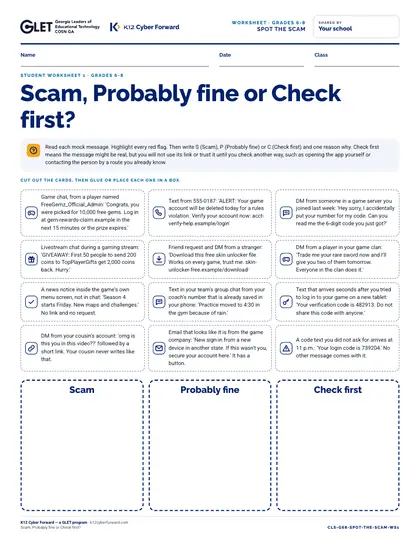
First page preview of Spot the scam (grades 6-8)

What's inside

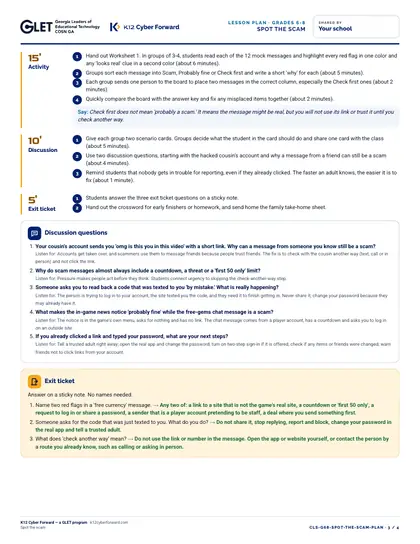
  • Lesson plan: objectives, 5-part sequence with teacher scripts, discussion questions, exit ticket, differentiation (PDF + Word)
  • Worksheet 1: Scam, Probably fine or Check first?
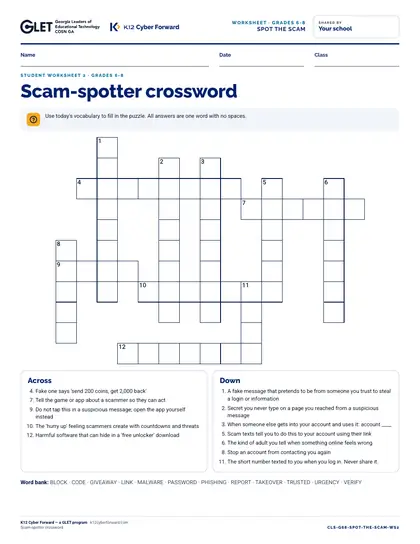
  • Worksheet 2: Scam-spotter crossword
  • Teacher answer key for every worksheet, card and the exit ticket
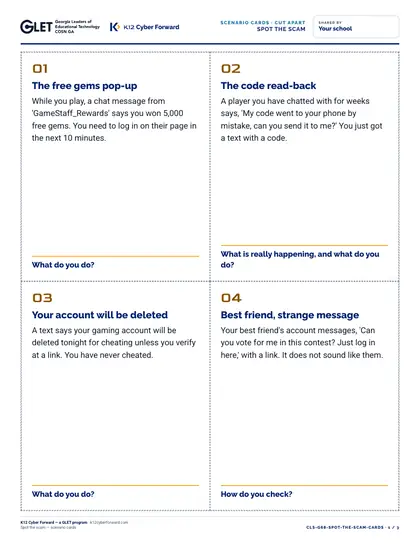
  • 10 cut-apart scenario cards
  • 8-slide outline with speaker notes (PDF + editable PowerPoint)
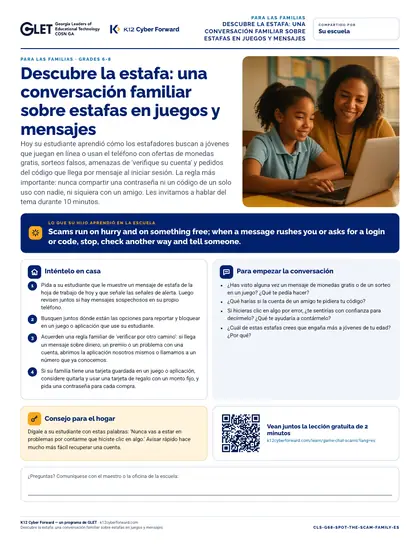
  • Family take-home sheet in English and Spanish (PDF + Word)

Learners will be able to

  • Name four common scam hooks in game chat, DMs and texts: free currency, 'verify your account' threats, fake giveaways and requests for a one-time code
  • Find at least three red flags in a mock message, such as a countdown, a lookalike link or a request for a password or code
  • Sort messages into Scam, Probably fine or Check first and explain the reasoning
  • Describe the report, block and tell-an-adult routine, and how to check a message by going to the app or a known contact directly

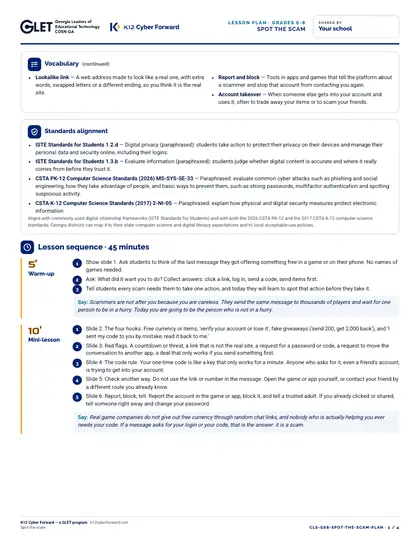
Standards alignment

  • ISTE Standards for Students 1.2.d
  • ISTE Standards for Students 1.3.b
  • CSTA PK-12 Computer Science Standards (2026) MS-SYS-SE-33
  • CSTA K-12 Computer Science Standards (2017) 2-NI-05

More pages

Files

Downloadable files
FileFormatLanguageSizeDownload
Teacher lesson plan (PDF)PDFEnglish207 KBDownload Teacher lesson plan (PDF)
Teacher lesson plan (editable Word)DOCXEnglish66 KBDownload Teacher lesson plan (editable Word)
Student worksheet 1: Scam, Probably fine or Check first? (PDF)PDFEnglish142 KBDownload Student worksheet 1: Scam, Probably fine or Check first? (PDF)
Student worksheet 2: Scam-spotter crossword (PDF)PDFEnglish69 KBDownload Student worksheet 2: Scam-spotter crossword (PDF)
Teacher answer key (PDF)PDFEnglish84 KBDownload Teacher answer key (PDF)
10 cut-apart scenario cards (PDF)PDFEnglish143 KBDownload 10 cut-apart scenario cards (PDF)
Slide outline with speaker notes (PDF)PDFEnglish87 KBDownload Slide outline with speaker notes (PDF)
Slides, 10 editable PowerPoint slidesPPTXEnglish78 KBDownload Slides, 10 editable PowerPoint slides
Family take-home sheet (English, PDF)PDFEnglish116 KBDownload Family take-home sheet (English, PDF)
Family take-home sheet (English, editable Word)DOCXEnglish61 KBDownload Family take-home sheet (English, editable Word)
Family take-home sheet (Español, PDF)PDFEspañol119 KBDownload Family take-home sheet (Español, PDF)
Family take-home sheet (Español, editable Word)DOCXEspañol62 KBDownload Family take-home sheet (Español, editable Word)

How to use and print

Print the lesson plan single-sided for the teacher. Print worksheets one per student (B/W is fine). Print scenario cards on card stock and cut along the dashed lines (4 per page). Family sheets go home in English or Spanish.

Participating districts download the same files co-branded with their own name and logo, and the QR codes count scans for their campaign reports.

Supports these rubric areas

  • Awareness & Training
  • Identity Management, Authentication, and Access Control
  • NIST CSF PR.AT
  • NIST CSF PR.AA

Part of

Cyber Academy course · Students, Teachers

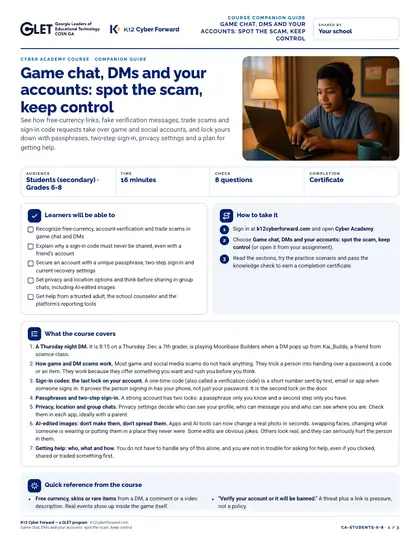
Game chat, DMs and your accounts: spot the scam, keep control

See how free-currency links, fake verification messages, trade scams and sign-in code requests take over game and social accounts, and lock yours down with passphrases, two-step sign-in, privacy settings and a plan for getting help.
  • 16-minute course
  • Grades 6-8
  • English
  • Online course (sign in)

Classroom lesson · Teachers, Students

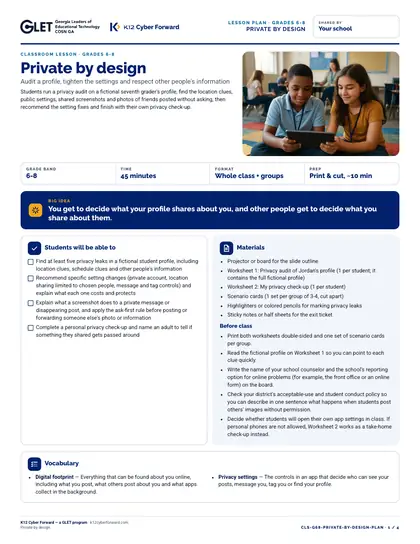
Private by design

Students run a privacy audit on a fictional seventh grader's profile, find the location clues, public settings, shared screenshots and photos of friends posted without asking, then recommend the setting fixes and finish with their own privacy check-up.

  • 45-minute lesson
  • Grades 6-8
  • English · Español
  • DOCX, PDF, PPTX

Flash-n-Flush one-pager · Students

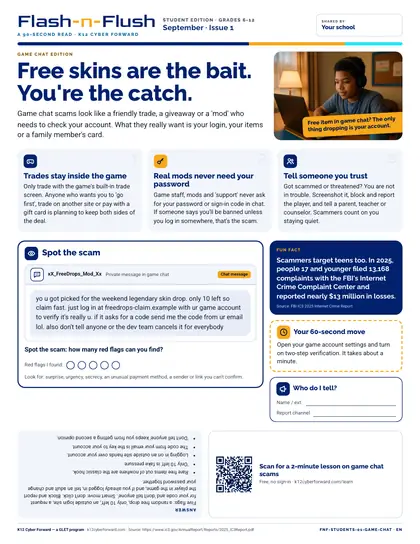
Free skins are the bait. You're the catch.

September student edition for students in grades 6-12. Game chat scams look like a friendly trade, a giveaway or a 'mod' who needs to check your account.

  • 90-second read
  • Grades 6-12
  • English · Español
  • PDF

Cyber Academy course · Students, Teachers

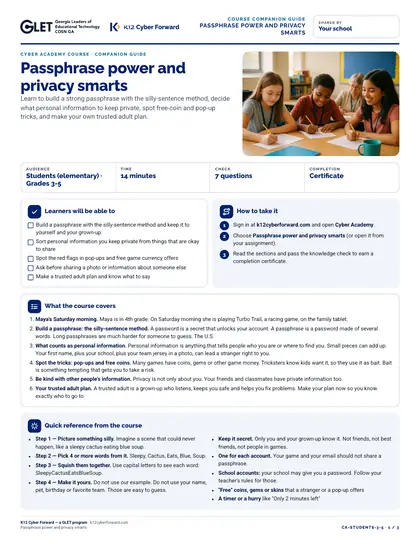
Passphrase power and privacy smarts

Learn to build a strong passphrase with the silly-sentence method, decide what personal information to keep private, spot free-coin and pop-up tricks, and make your own trusted adult plan.

  • 14-minute course
  • Grades 3-5
  • English
  • Online course (sign in)

Sources