Self-assessed
Your district team establishes its own baseline and records the current practice.
- Who leads
- District assessment team
- What supports it
- Scope, ratings and written rationale
- Where it leads
- Owned priorities and practical next steps


Georgia K-12 cybersecurity program · GLET, Georgia's CoSN chapter
K12 Cyber Forward, a GLET program, helps Georgia school districts benchmark against the Cybersecurity Rubric 2.0, prioritize the work and document progress—together, as Georgia's education technology community.

About the program
K12 Cyber Forward is a cybersecurity improvement program for Georgia public school districts, run by GLET, Georgia's chapter of CoSN (the Consortium for School Networking). Districts assess their cybersecurity maturity with the Cybersecurity Rubric 2.0—22 categories organized under the six NIST Cybersecurity Framework 2.0 functions, each described across five maturity levels—then plan owned improvements, keep supporting evidence and choose the level of review that fits.
Supportive, not punitive: district results are never ranked publicly, and a score is where the conversation starts.
For the leaders behind every school day
Cyber resilience reaches beyond the technology office. Bring the right people into a shared plan without losing clear ownership.
CIOs · technology directors · district IT teams
Establish the rubric baseline, identify gaps, assign practical actions and bring the supporting evidence into one district workspace.
Superintendents · cabinet leaders · district decision makers
Bring assessment findings into an understandable improvement plan, with clear owners, practical milestones and reports your leadership team and board can use.
Business officials · human resources · finance · school operations
Coordinate account lifecycle, access reviews, vendor agreements, insurance renewal evidence and recovery work with the people responsible for each part of the school day.
Built on the Cybersecurity Rubric 2.0
Work through 22 categories across the six NIST CSF 2.0 functions, record the rationale and connect the baseline to an improvement plan. A score starts the conversation; the follow-through makes it useful.
The six functions in plain language →Clarify accountability, policies, priorities and partner responsibilities so decisions can be followed through.
6 categories: organizational context · risk management strategy · roles, responsibilities and authorities · policy · oversight · supply chain risk management
Know which systems, information and dependencies support school operations, and who is responsible for them.
3 categories: asset management · risk assessment · improvement
Focus on accounts, access, staff awareness and the protective practices that reduce unnecessary exposure.
5 categories: identity management, authentication and access control · awareness and training · data security · platform security · technology infrastructure resilience
Organize logging, monitoring and escalation so the district can recognize and investigate concerning activity.
2 categories: continuous monitoring · adverse event analysis
Agree on incident roles, communication paths and working procedures before a disruption creates pressure.
4 categories: incident management · incident analysis · incident response reporting and communication · incident mitigation
Use scoped recovery exercises, observed results and lessons to improve service restoration and continuity.
2 categories: incident recovery plan execution · incident recovery communication
Function and category names follow NIST CSF 2.0.
A guided approach, from the first conversation
After you request participation, the program team reviews the district and contact before preparing access. From there, every district follows the same five-stage journey at its own pace.


The journey at a glance: five stages, repeated as practice matures.
The right support for the work in front of you
Keep the district's rubric ratings and the level of review visible as separate measures.
Your district team establishes its own baseline and records the current practice.
A named facilitator helps the team examine its baseline and work through questions.
A named third-party verifier reviews the stated scope and shared supporting evidence.
Inside the portal
Between assessments is where improvement happens. The private portal gives every role a clear place to pick up the work, see progress and share it.
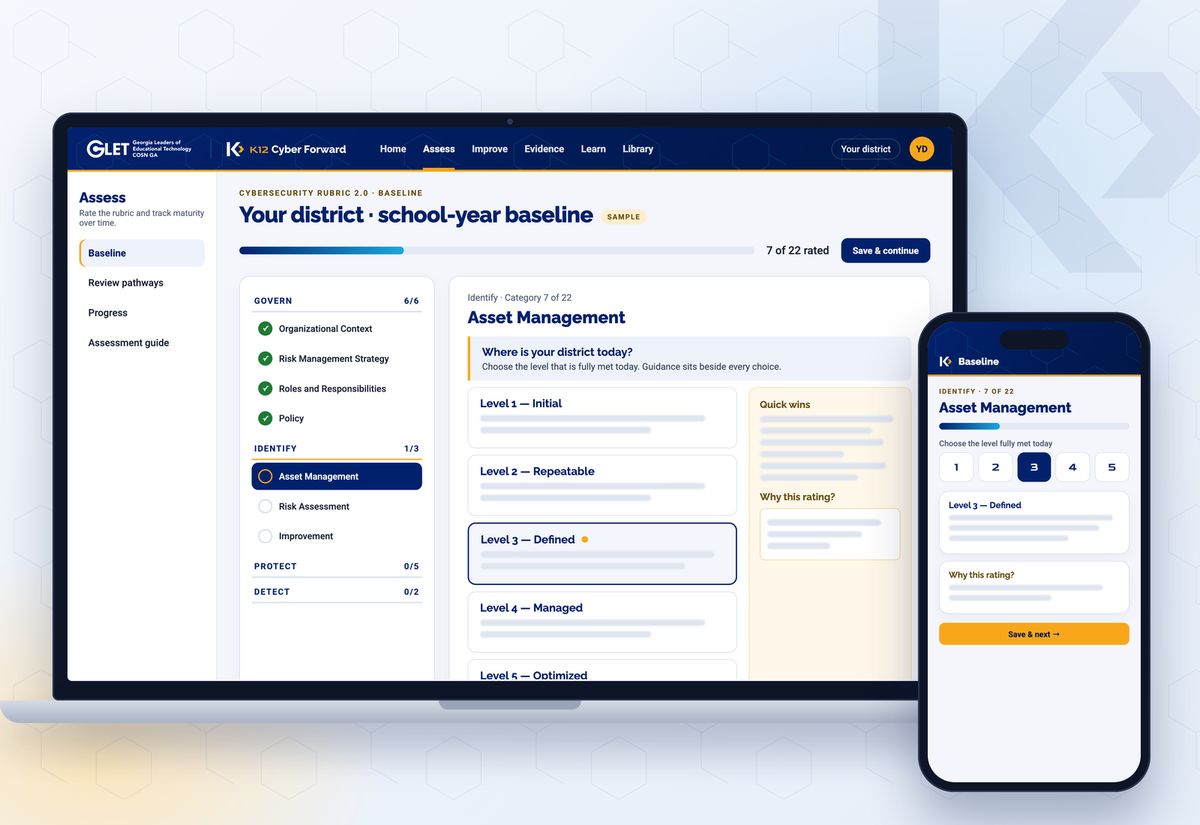
Measure
Rate all 22 categories together, with guidance beside every question.
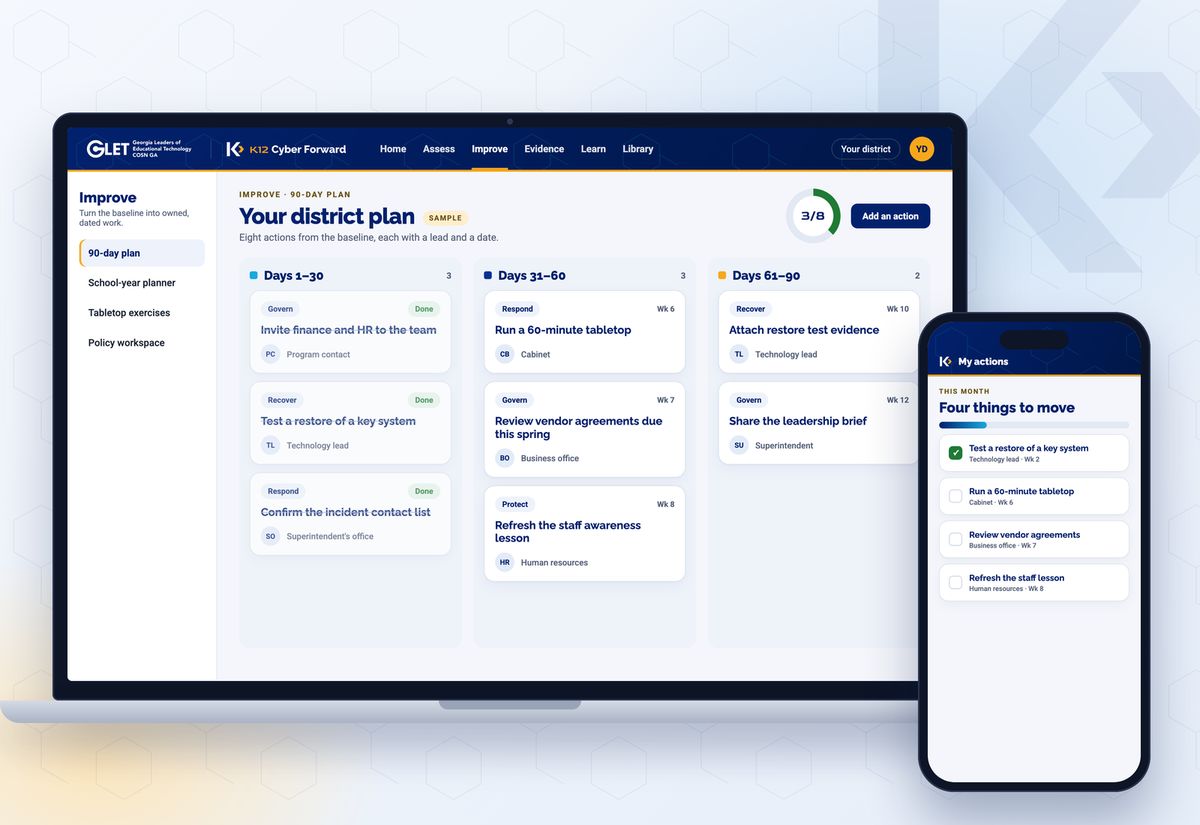
Prioritize
Three to six priorities, each with a named lead and a date.
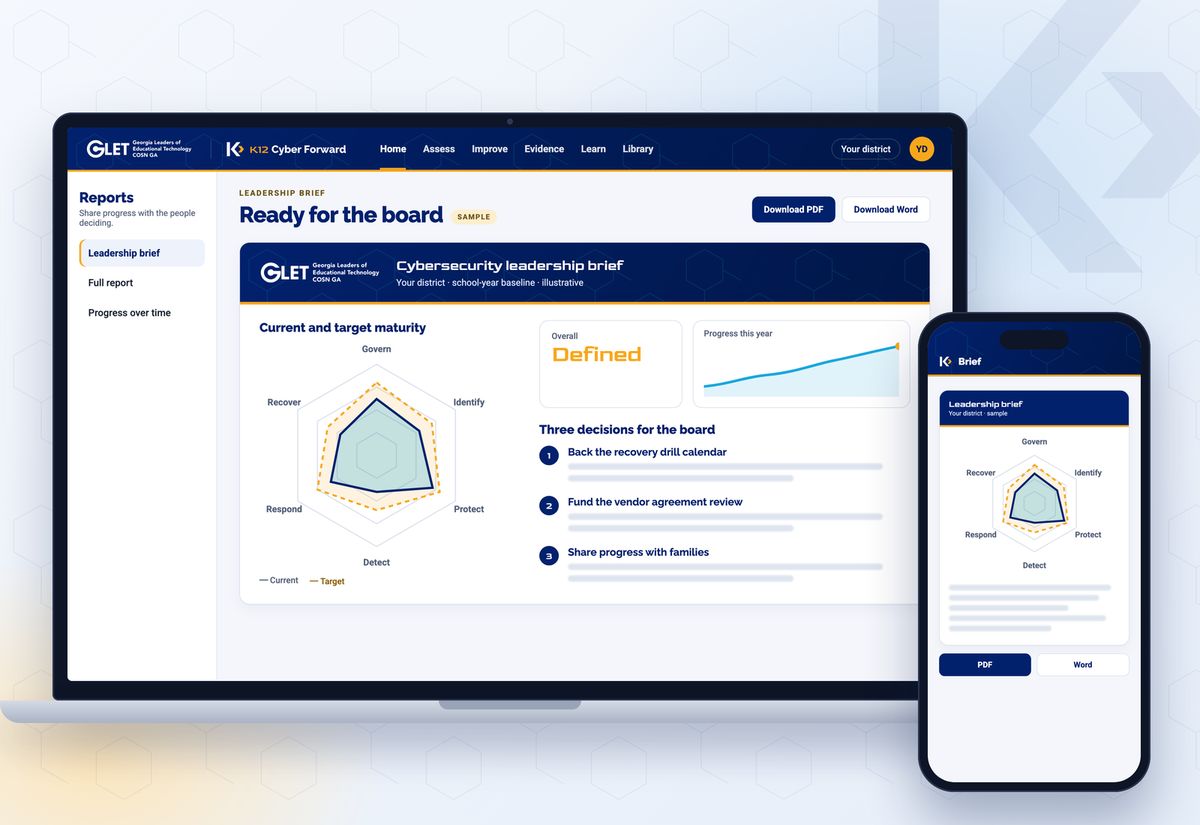
Why it matters for Georgia schools
Georgia's public schools serve about 1.7 million students across 181 school districts. National research shows what is at stake when systems go down, and why districts are acting together.
Georgia figures: Georgia Department of Education (students) and GLET (districts served).
School-community resources
Give students, families and staff a clear way to recognize concerns and ask for help.
One school community
Three ways to put safety into practice



Every audience can use the same three-step habit.
Ready for school conversationsIllustrated handouts, discussion guides and presentation resources in your district's private library.
Sign in for resourcesResources

Frameworks · 6 min read
A plain-language guide to the self-assessment many school systems use to measure cybersecurity maturity: who publishes it, how it is built, how it fits with other frameworks, and how a Georgia district can set an honest baseline.

Frameworks · 6 min read
K12 Cyber Forward measures districts with the Cybersecurity Rubric 2.0, a K-12 maturity rubric organized around the six functions of the NIST Cybersecurity Framework 2.0. This guide explains how the two fit together, what each function means on an ordinary school day, and a first step a Georgia district can take this month.

Incident readiness · 6 min read
Run your next tabletop as if the attack started at 6:40 on a Tuesday morning. This checklist follows a Georgia district from preparation through the first hour, the first day, recovery and the after-action review.
GLET connects education technology leaders with shared resources, professional learning and a statewide community of practice. K12 Cyber Forward brings that community to cybersecurity.
A district technology leader or another authorized contact who can coordinate participation with district leadership.
Start with your professional contact information. Once access is prepared, your team can agree on assessment scope and gather redacted supporting evidence in the private portal.
GLET reviews the district and the contact before preparing any account access. You receive a private receipt link to check the status of your request. Nothing is provisioned automatically.
No. The portal provides original practical guidance and knowledge checks. Formal rubric training and licensing follow the publisher's own programs and terms.
Begin with the people. Build on the work.
Bring your district's cyber improvement work into K12 Cyber Forward.
