Cyber Academy course · Grades 6-8

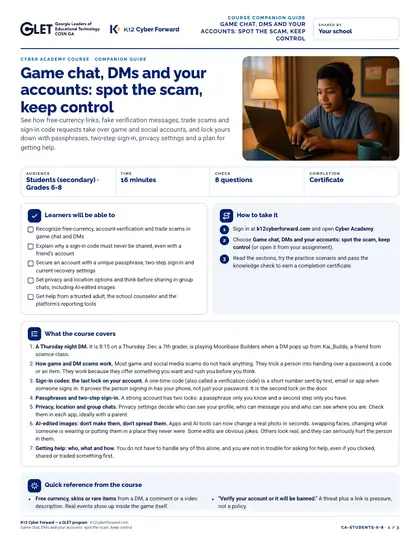
Game chat, DMs and your accounts: spot the scam, keep control

A 16-minute Cyber Academy course for students (secondary) (grades 6-8). See how free-currency links, fake verification messages, trade scams and sign-in code requests take over game and social accounts, and lock yours down with passphrases, two-step sign-in, privacy settings and a plan for getting help. 7 sections, 8-question knowledge check, a branching practice scenario and a completion certificate. The companion guide gives managers the outline, a huddle plan and the answer key.

Time to use
16-minute course
Audience
Students, Teachers
Grade band
Grades 6-8
Language
English
Formats
PDF
First page preview of Game chat, DMs and your accounts: spot the scam, keep control

What's inside

  • Section: A Thursday night DM
  • Section: How game and DM scams work
  • Section: Sign-in codes: the last lock on your account
  • Section: Passphrases and two-step sign-in
  • Section: Privacy, location and group chats
  • Section: AI-edited images: don't make them, don't spread them
  • Section: Getting help: who, what and how
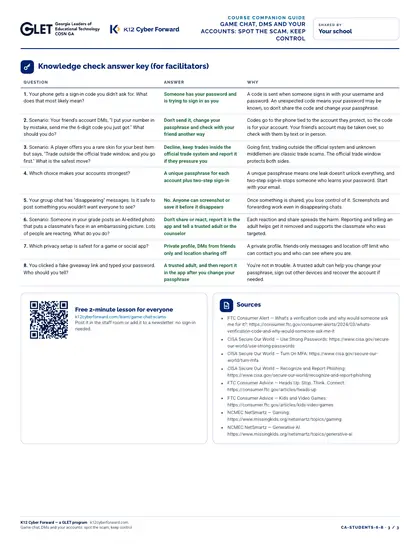
  • 8-question knowledge check with explanations
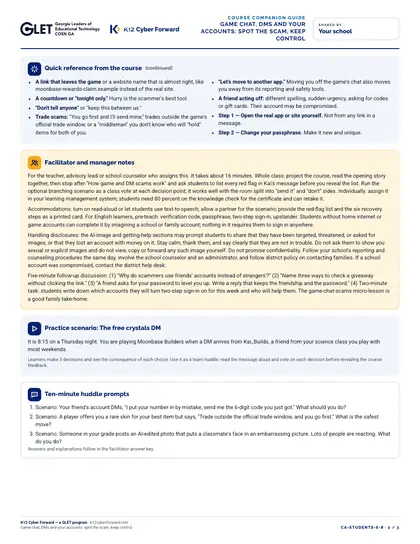
  • Branching scenario: The free crystals DM
  • Completion certificate (named accounts)
  • Printable companion guide with facilitator notes and answer key

Learners will be able to

  • Recognize free-currency, account-verification and trade scams in game chat and DMs
  • Explain why a sign-in code must never be shared, even with a friend's account
  • Secure an account with a unique passphrase, two-step sign-in and current recovery settings
  • Set privacy and location options and think before sharing in group chats, including AI-edited images
  • Get help from a trusted adult, the school counselor and the platform's reporting tools

More pages

How to use and print

The course runs in Cyber Academy; this companion guide prints double-sided on Letter for managers and facilitators.

Participating districts download the same files co-branded with their own name and logo, and the QR codes count scans for their campaign reports.

Supports these rubric areas

  • Awareness & Training
  • Identity Management, Authentication, and Access Control
  • Data Security
  • NIST CSF PR.AT
  • NIST CSF PR.AA
  • NIST CSF PR.DS

Part of

Classroom lesson · Teachers, Students

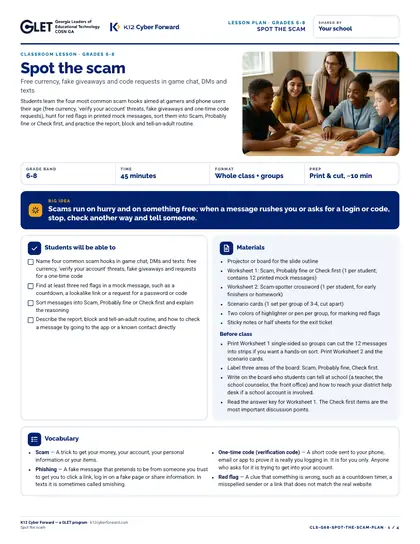
Spot the scam

Students learn the four most common scam hooks aimed at gamers and phone users their age (free currency, 'verify your account' threats, fake giveaways and one-time code requests), hunt for red flags in printed mock messages, sort them into Scam, Probably fine or Check first, and practice the report, block and tell-an-adult routine.
  • 45-minute lesson
  • Grades 6-8
  • English · Español
  • DOCX, PDF, PPTX

Classroom lesson · Teachers, Students

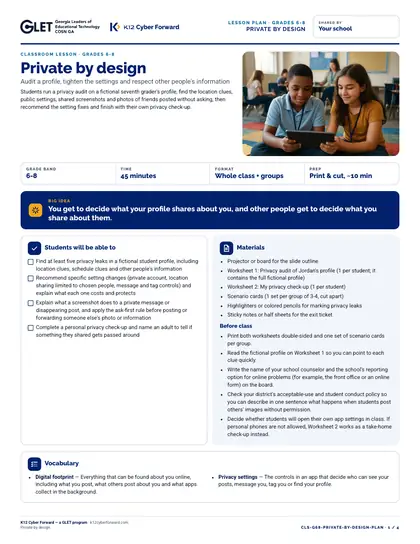
Private by design

Students run a privacy audit on a fictional seventh grader's profile, find the location clues, public settings, shared screenshots and photos of friends posted without asking, then recommend the setting fixes and finish with their own privacy check-up.

  • 45-minute lesson
  • Grades 6-8
  • English · Español
  • DOCX, PDF, PPTX

Flash-n-Flush one-pager · Students

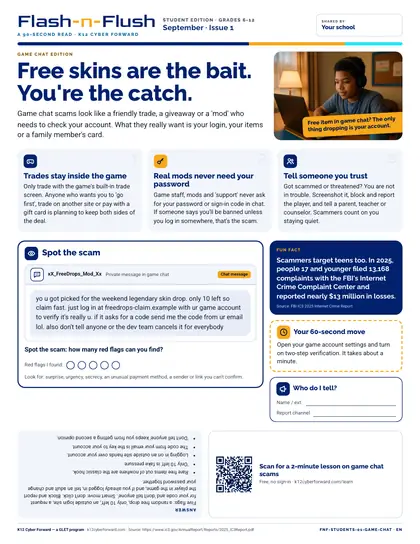
Free skins are the bait. You're the catch.

September student edition for students in grades 6-12. Game chat scams look like a friendly trade, a giveaway or a 'mod' who needs to check your account.

  • 90-second read
  • Grades 6-12
  • English · Español
  • PDF

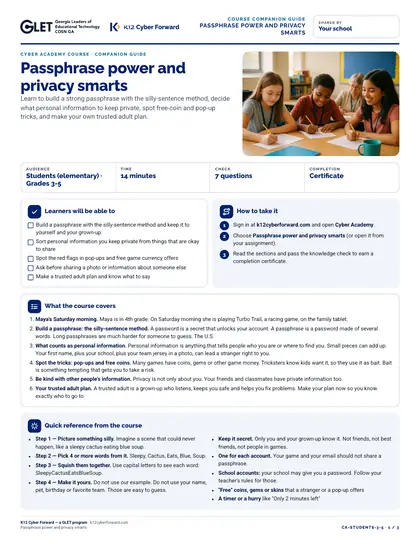
Cyber Academy course · Students, Teachers

Passphrase power and privacy smarts

Learn to build a strong passphrase with the silly-sentence method, decide what personal information to keep private, spot free-coin and pop-up tricks, and make your own trusted adult plan.

  • 14-minute course
  • Grades 3-5
  • English
  • Online course (sign in)

Sources